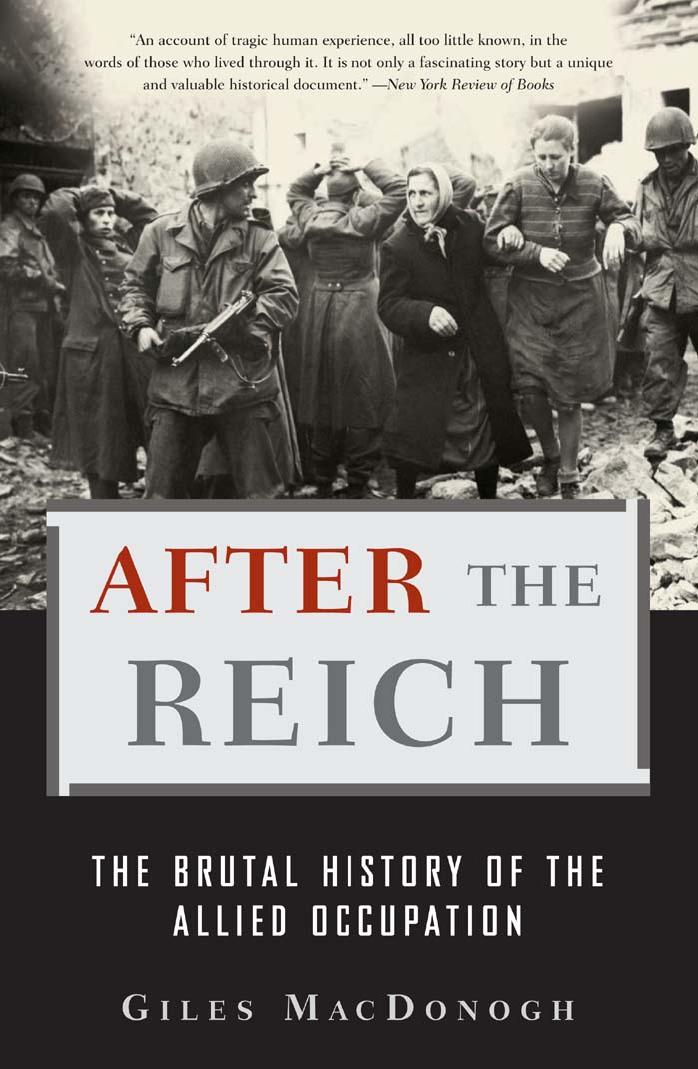
After the Reich: The Brutal History of the Allied Occupation by Giles MacDonogh
Author:Giles MacDonogh [MacDonogh, Giles]
Language: eng
Format: epub, pdf
Tags: History, Germany, Military, World War II, Non-Fiction
ISBN: 9780465003389
Google: GcWxhlQVnHIC
Amazon: 0465003389
Publisher: Basic Books
Published: 2009-02-24T05:00:00+00:00
362
guilt
And we are starving them, not deliberately in the sense that we definitely want them to die, but wilfully in the sense that we prefer their death to our own inconvenience.’98 Over and over again in his letters to his wife, he is struck by the fact that these suffering infants might have been his own children.
From newspaper reports Gollancz prepared a chilling indictment: seven-tenths of people in the now British city of Hamburg had no bread for two weeks of every month. He quoted the UNRRA figure for daily subsistence – 2,650 calories. The minimum needed to sustain life was 2,000. In March 1946 the average for the British Zone had fluctuated between 1,050 and 1,591. This consisted of four and a half slices of dry bread, three middle-sized potatoes, three tablespoons of oatmeal, half a cup of skimmed milk, a scrap of meat and a tiny dollop of fat. At those levels you could survive in bed, but could not work. Then at the end of February the rations had been cut to 1,014 for those not doing heavy work, that is women. Infant mortality was now at ten times the rate of 1944. In Dortmund in February 1946 forty-six out of 257 children born that month perished.99
Politicians and soldiers – like Sir Bernard Montgomery – insisted that no food be sent from Britain. Starvation was punishment. Montgomery said that three-quarters of all Germans were still Nazis – although he did not reveal the source of his information. The Germans had only themselves to blame, and they should be last in the queue. The economist and chancellor of the Exchequer Hugh Dalton argued that the cost of the occupation was tantamount to paying reparations to the Germans.100 Britain itself was recovering from the wartime dearth, however. The food minister John Strachey had proudly announced that meat consumption was at 98 per cent of pre-war levels, and that the British were eating 50 per cent more fish.101
As Gollancz presciently wrote, Germany had been stripped of its bread basket cum milk-churn in the east, the pastures of Pomerania and East Prussia.102 Meanwhile the British authorities in Germany were proposing to cut the rations back to 1,000 calories. The French were already at 950, while the Americans were not much more generous at 1,270. Gollancz pointed out that the inmates at Belsen had 800, which was not that much less.103 In Baden-Baden, Alfred Döblin was suspicious: if they really had so little food they would be dead. He thought most of them were managing to supplement their diet from the black market.104 That didn’t necessarily help the old and infirm, however.
Gollancz followed The Ethics of Starvation with a further tract in January 1947. In Darkest Germany was the result of a six-week tour of the British 363
crime and punishment
Zone which the publisher made in October and November 1946, just before the frost. It consists of eighteen letters and articles he had written to belabour the government. He regretted he had been unable to make it to Berlin.
Download
After the Reich: The Brutal History of the Allied Occupation by Giles MacDonogh.pdf
This site does not store any files on its server. We only index and link to content provided by other sites. Please contact the content providers to delete copyright contents if any and email us, we'll remove relevant links or contents immediately.
| Africa | Americas |
| Arctic & Antarctica | Asia |
| Australia & Oceania | Europe |
| Middle East | Russia |
| United States | World |
| Ancient Civilizations | Military |
| Historical Study & Educational Resources |
The Radium Girls by Kate Moore(12028)
100 Deadly Skills by Clint Emerson(4926)
Rise and Kill First by Ronen Bergman(4790)
The Templars by Dan Jones(4689)
The Doomsday Machine by Daniel Ellsberg(4490)
The Rape of Nanking by Iris Chang(4213)
Killing England by Bill O'Reilly(4004)
Stalin by Stephen Kotkin(3968)
Hitler in Los Angeles by Steven J. Ross(3946)
12 Strong by Doug Stanton(3550)
Hitler's Monsters by Eric Kurlander(3343)
Blood and Sand by Alex Von Tunzelmann(3205)
The Code Book by Simon Singh(3189)
Darkest Hour by Anthony McCarten(3133)
The Art of War Visualized by Jessica Hagy(3008)
Hitler's Flying Saucers: A Guide to German Flying Discs of the Second World War by Stevens Henry(2754)
Babylon's Ark by Lawrence Anthony(2679)
The Second World Wars by Victor Davis Hanson(2526)
Tobruk by Peter Fitzsimons(2518)
